27 May, 2026
Yesterdays To do!
getting started: Hénon Heils Model
Comments for the day:
I first worked on some further workflow questions. Including a bash script for adding entries from the ‘glossary.json’ to the ‘glossary.qmd’ file and to the ’_quarto.qmd’ file, for latex macros or to initiate the day-log by the use of templates.
I use the ai-tool provided by claude to help generate the bash-scripts for workflow and to communicate about the structure of my workspace. I have general idea from previous projects how I want to structure my workspace - though I do not have the knowledge in coding in ‘bash’ or ‘yml’ etc…
So I use ai to set up my folder structure and to prepare the workflow. I also need to keep track of my ai usage for transparency.
suggested structure
- derivation
- considering derivation
- numerical implementation
observations
- original paper by Henon and Heiles Hénon and Heiles (1964)
- I came across, need to undertand: 6-D phase space -> 5 independant conservative integrals of the motion; seemingly, sure but I want a rigorous understanding
- results in 5 hyper surfaces, their intersections define the trajectories
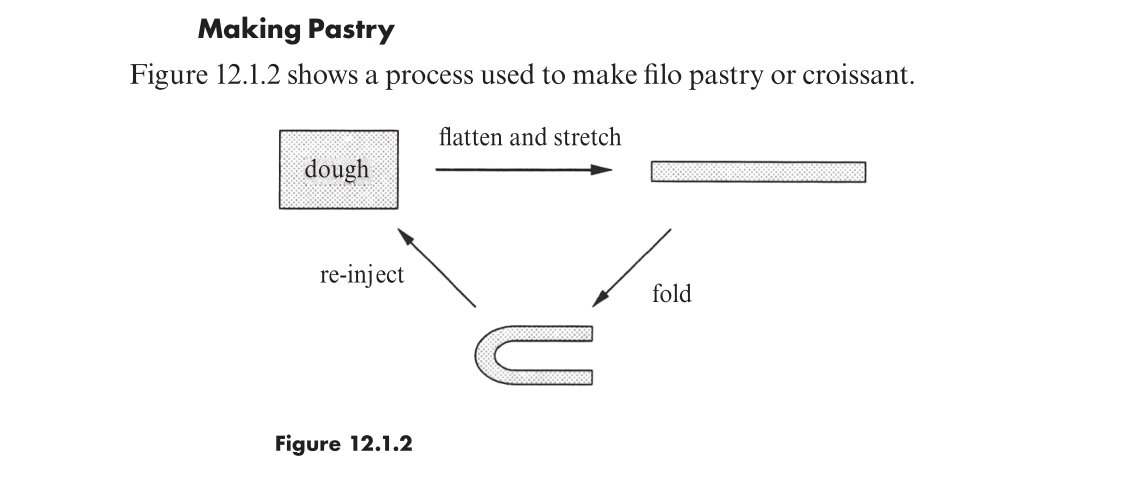
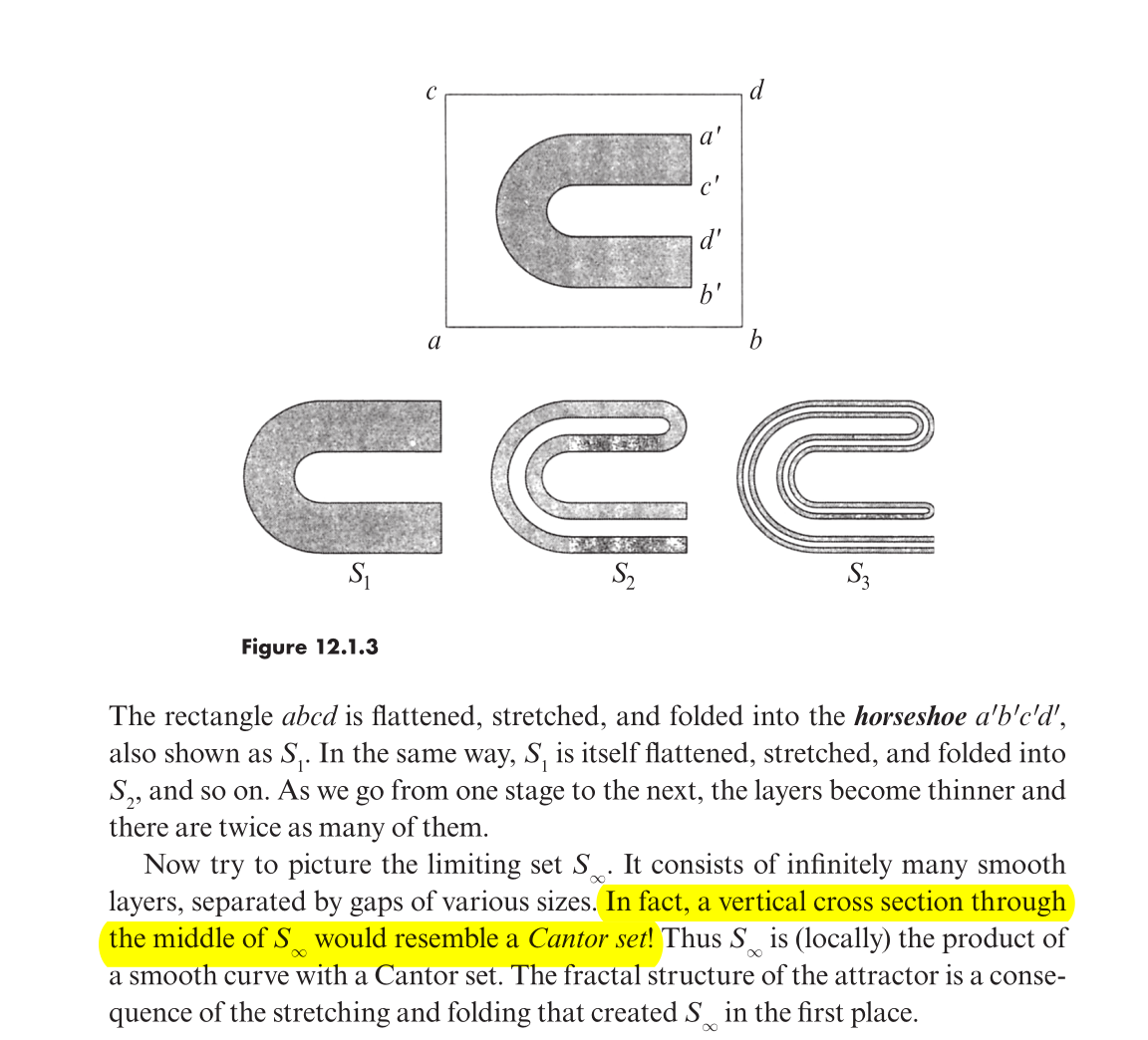
- literature by Strogatz (2015) under chapter 12 strange attractors
- wikipedia
- ‘orbit diagram’ or ‘bifracation diagram’
- is the Héno Map the same as the Hénon–Heiles model? I dont think so!
Lost Wanders Thoughts:
- connections of strange attractor to Cantor Set (Arnold1989?) p. 430-431;
- gets me to think about how ternary number representation (base 3) is a useful way to analyze the Cantor set
…
References
Hénon, Michel, and Carl Heiles. 1964. “The Applicability of the Third Integral of Motion: Some Numerical Experiments.” The Astronomical Journal 69 (1): 73–79. https://doi.org/10.1086/109234.
Strogatz, Steven H. 2015. Nonlinear Dynamics and Chaos: With Applications to Physics, Biology, Chemistry, and Engineering. 2nd ed. CRC Press. https://doi.org/10.1201/9780429492563.